
Run a fingertip across a puffy sticker and the design lifts slightly before your eye has finished processing it. That small dome is doing something a flat sticker can't — it turns a decal into an object with genuine presence, which is exactly why puffy stickers show up so often on kids' products, party favors, and playful brand merchandise. The format invites touch, not just a glance.
It's also a format that gets used in the wrong places sometimes, simply because it's fun. Knowing how a puffy sticker is actually built makes it easier to tell when the dome is earning its keep and when a flat sticker would do the job better.
What Actually Makes a Sticker "Puffy"
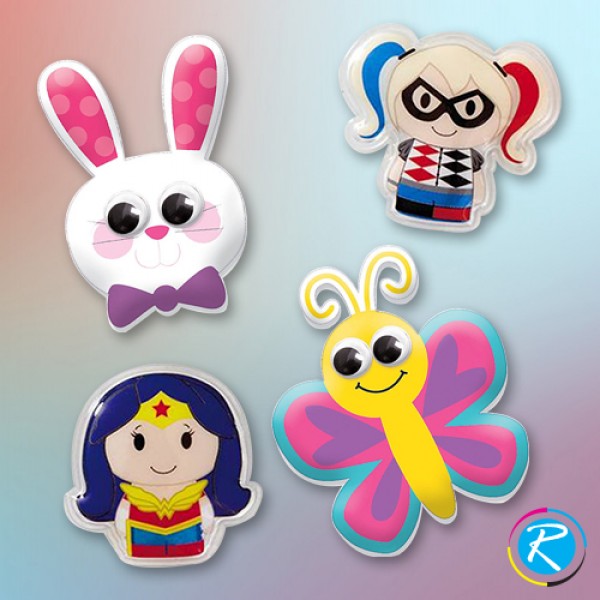
A puffy sticker is built from two layers rather than one. The design is printed onto a top layer of clear or white vinyl, and that printed vinyl is then laminated over a foam backing cut to the same shape. The foam is what creates the dome: as the vinyl top is bonded and sealed over it, the surface rounds upward at the edges and holds a soft, raised profile instead of lying flat against the material underneath. The result has real thickness, usually a couple of millimeters, and catches light differently across its curve than a flat sticker of the same design ever could.
The die-cutting step is what ties the two layers together into a clean finished shape. Because the foam and the printed vinyl are cut as a matched pair rather than separately trimmed, the edge of the finished sticker stays consistent all the way around, without the vinyl overhanging the foam or the foam peeking out past the printed edge. That precision is part of why puffy stickers read as manufactured rather than assembled — the dome and the outline both come from the same cutting pass.
Why the Dome Reads as Tactile and Premium at Once
Most decisions to touch or pick something up happen before conscious thought catches up, and a raised surface is one of the strongest visual cues that something is worth touching. That's the psychological trick a puffy sticker pulls off cheaply — it borrows a cue usually associated with hand-finished or hand-crafted objects and applies it to something that's actually mass-produced on a die-cutting line. For a younger audience especially, the dome also reads as toy-like rather than purely decorative, which is part of why puffy stickers get collected, traded, and stuck to notebooks and water bottles rather than simply applied once and forgotten.
There's also a durability side-effect that's easy to overlook: the laminated vinyl top layer doesn't just create the dome, it also seals the printed design underneath from direct fingertip contact and light surface abrasion. A flat sticker's print sits closer to the surface being touched; a puffy sticker's print sits under a rounded, sealed cap. For an object that's going to be handled constantly — a notebook cover, a water bottle carried in a backpack — that extra layer of physical separation between fingers and ink is a real, if secondary, advantage.
Where Puffy Stickers Are the Right Call
The format earns its cost premium wherever tactile appeal and playfulness are actually part of the product's value, not an afterthought. Children's product packaging, party favor bags, mascot or character merchandise, and promotional giveaways aimed at a younger or more casual audience are the clearest fits — the dome does real work turning a giveaway into something worth keeping. It also performs well on apparel and gear meant to look personalized and a little handmade: patches applied to backpacks, jackets, and water bottles benefit from the same tactile cue that makes them fun to peel and collect in the first place.
Where a Flat Sticker Is Still the Better Choice
Dimension isn't free, and it isn't always the right tool. Fine detail and small type get lost on a domed surface the way they don't on a flat one, because the curve distorts how light hits the printed layer and softens sharp edges at a glance. Puffy construction also adds real cost per unit, which makes it a poor fit for large-volume giveaways where a flat vinyl sticker at a fraction of the price does the same branding job. And in a professional or corporate context — a product label, a compliance sticker, anything that needs to read as serious rather than playful — the tactile, toy-adjacent quality of a puffy sticker actively works against the message. Long-term outdoor durability is worth a second look too: a foam-backed construction has more edge and seam than a single-layer vinyl decal, which over years of sun and moisture exposure gives it more opportunities to lift at the perimeter than a flat, fully-laminated sticker.
How Foam-Backed Puffy Differs From Resin-Domed Stickers
Foam-backed construction isn't the only way to get a dimensional sticker, and it's worth knowing the difference before assuming "puffy" covers every raised option. Resin-domed stickers, sometimes sold as crystal or epoxy stickers, are built differently — a flat printed decal is finished with a poured clear resin that self-levels and cures into a hard, glass-like dome rather than a soft, squeezable one. The two read very differently in the hand: foam-backed puffy stays slightly compressible and forgiving, which is part of what makes it feel toy-like, while a resin dome is rigid and glossy, closer to the finish on a bottle cap or an automotive emblem. Resin domes also tend to sit at a higher price point and show up more often in adult-facing branded merchandise — lapel pins, appliance badges, premium bottle labels — where a hard, jewel-like shine reads as more refined than a soft, playful one. Neither is more "correct" than the other; they're built for different tactile impressions.
Getting the Order Right
Because the dome is formed during lamination rather than printed, the artwork itself should stay relatively simple — bold shapes and solid color blocks translate far better through the foam-and-vinyl build than dense linework does. Sheets of individually die-cut puffy stickers are the standard format, which also makes it easy to mix several small designs, like an assortment of characters or icons, into a single order without needing separate setups for each shape. Size matters more here than on a flat sticker too: very small dimensions (well under an inch) can struggle to hold a visible, well-formed dome, since there isn't enough surface area for the foam to round convincingly, while very large formats can add enough material cost and rigidity that the sticker stops folding naturally around a curved surface. A size range roughly between one and three inches tends to hold the dome shape most reliably across the widest range of applications. Our puffy stickers are produced to this same foam-and-vinyl spec.
The Bottom Line
A puffy sticker isn't a fancier version of a regular sticker — it's a different tool built for a specific reaction: pick me up, feel this, keep this. Used where that reaction matters, the foam-and-vinyl construction earns its cost easily. Used where legibility, bulk economy, or a serious tone matters more, a flat sticker will outperform it every time. The right question before ordering isn't which format looks nicer on a proof sheet — it's which one matches how the audience is actually going to encounter the sticker, in a hand, on a shelf, or from across a room. Both formats sit within our broader stickers range.